
I recently had the privilege of hearing Alan Mulally speak at an event hosted by the BYU Management Society. As someone who has studied and coached leadership teams for years, I can confidently say this: Alan’s leadership journey—and the way he speaks about people, culture, and alignment—is a masterclass in what Pinnacle leadership looks like in practice.
From his time at Boeing to his transformational tenure at Ford Motor Company, Alan didn’t rely on charisma or command-and-control leadership. He relied on a simple, disciplined philosophy he calls “Working Together.”
And it worked—at the highest levels, under immense pressure.
The Power of a “Working Together” Culture
One of the most powerful lessons from Alan’s story is that culture is not a side conversation—it is the strategy.
When Alan stepped into Ford during one of the most difficult periods in the company’s history, the business was losing billions of dollars. The path forward wasn’t secrecy, heroics, or fear-based accountability. It was alignment.
By clearly articulating the vision, creating transparency around reality, and insisting that leaders work together rather than protect silos, Ford stabilized and returned to profitability—without government bailouts.
This is People & Culture leadership at its best:
- A shared direction everyone understands
- Clear standards for behavior and collaboration
- Trust built through consistency, not slogans
When people and culture align, execution follows.
Leadership Starts with People—Always
Alan repeatedly emphasized a truth that Pinnacle leaders know well: leadership begins with people, not plans.
He challenged leaders to genuinely care for their teams—not in a superficial or performative way, but by creating environments where people feel respected, trusted, and accountable.
One statement stood out above the rest: “The purpose of life is to love and be loved—in that order.”
That principle carries directly into leadership. When leaders lead with care, clarity, and respect, people respond with commitment, energy, and ownership. Culture strengthens. Results follow.
Transparency and Accountability Build Trust
Another defining element of Alan’s leadership was his insistence on transparency.
At Ford, leaders were expected to openly share challenges, progress, and concerns—without fear of punishment or embarrassment. This wasn’t about lowering standards. It was about raising the quality of conversation.
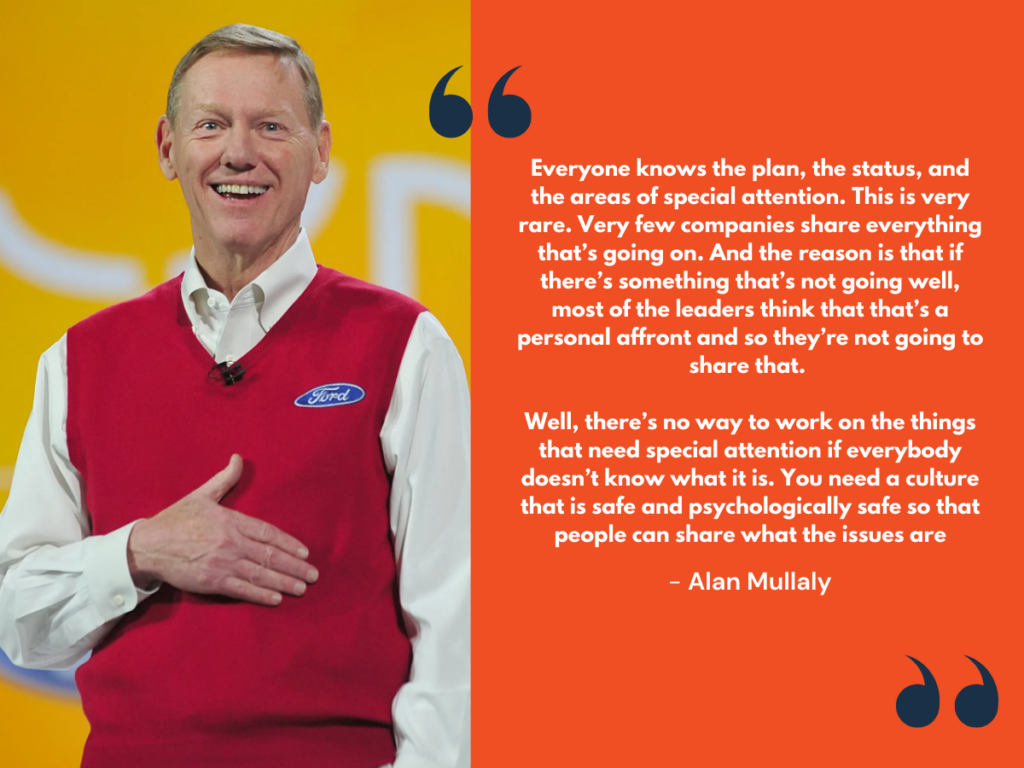
When people feel psychologically safe:
- Problems surface earlier
- Teams collaborate on solutions
- Accountability becomes collective, not personal
This is how high-performing cultures operate. Not by hiding issues—but by addressing them together.
What Business Leaders Can Learn from Mulally
As I reflected on Alan’s insights, several lessons stood out that apply directly to leadership teams of any size:
- Have a compelling direction – People rally behind clarity, not complexity
- Build inclusive cultures – Performance improves when everyone belongs
- Lead with humility and service – Leadership is about enabling others
- Stay resilient and optimistic – Change is inevitable; attitude matters
These are not abstract ideas. They are daily leadership choices that shape culture over time.
Why This Matters as a People & Culture Pillar
Strong cultures don’t emerge by accident.
They are built intentionally by leaders who:
- Value people as humans, not resources
- Create clarity around expectations and behavior
- Encourage collaboration over competition
- Address reality with honesty and optimism
Alan Mulally’s “Working Together” philosophy is a powerful real-world example of Pinnacle People & Culture leadership in action.
Moving Forward—Together
Whether you lead a startup, a family business, or a mature organization, the principles of working together—clarity, trust, accountability, and care—are timeless.
If you’re ready to strengthen your culture, align your leadership team, and create an environment where people and performance thrive together, I’d love to continue the conversation.