
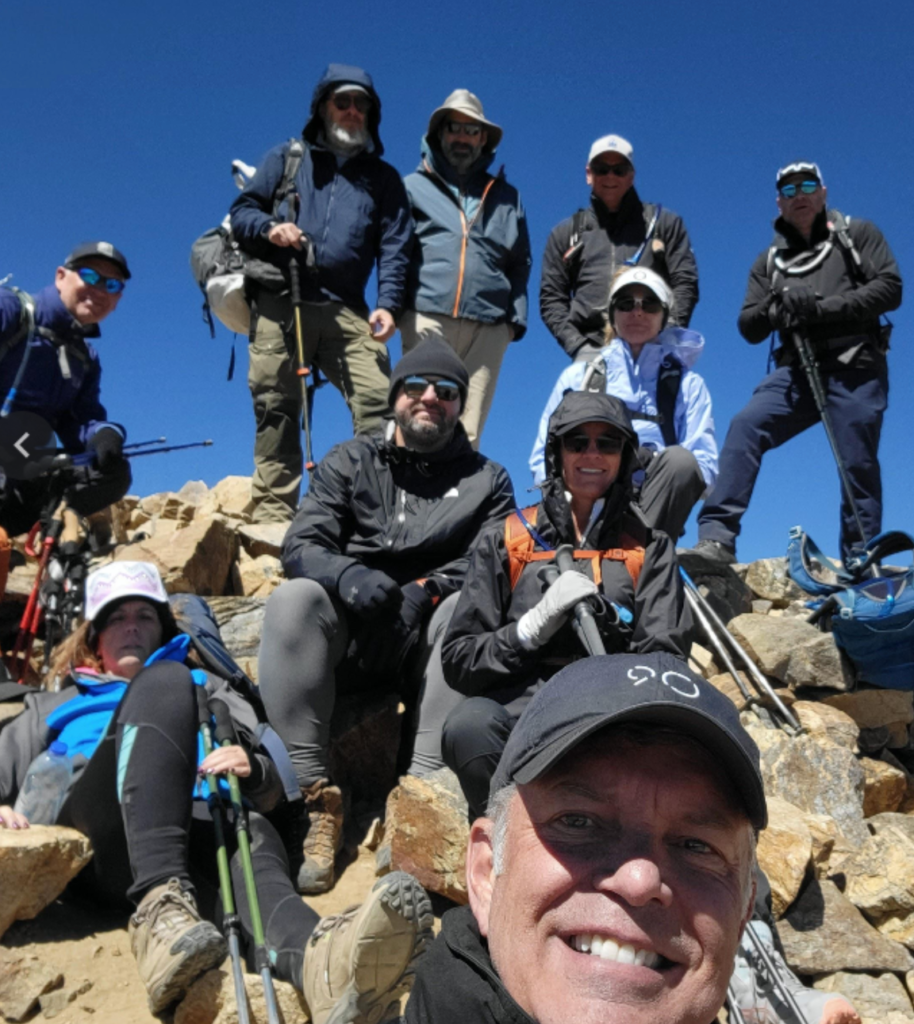
The Climb 2023 Team on the summit of the highest peak in Colorado, Mt Elbert at 14,439 ft.
Life—and leadership—is not a straight line. It is a climb marked by ascents and descents, clarity and confusion, momentum and resistance. Somewhere ahead of each of us stands a mountain. It represents what matters most: the future you want to build, the leader you are becoming, and the impact you know is possible but not yet fully realized.
The question is not whether you have a mountain.
The real question is: Do you see it clearly—and are you climbing it intentionally?
Step One: Seeing the Mountain Clearly
Every meaningful climb begins with awareness.
Where are you trying to go—really?
Not just this quarter or this year, but over the next chapter of your life and business.
Your mountain might be:
- A business that runs with discipline instead of chaos
- A leadership team that is aligned, accountable, and healthy
- A season of personal renewal—energy, health, or purpose
- Or a deeper desire to lead in a way that actually feels sustainable
Clarity matters because it becomes your compass. When the path gets steep—and it always does—knowing why you are climbing is what keeps you moving forward.
Pause for a moment and picture your summit.
What does success look like when you stand there?
Who are you when you arrive?
Step Two: Choosing a Path, Not Just a Goal
Big mountains are not conquered in a single push. They are climbed through deliberate stages—base camps, acclimation, and steady progress.
Once the summit is clear, the work becomes practical:
- What must change for this climb to be possible?
- What habits, systems, or patterns are holding you back?
- Who needs to be on the rope with you—and in what roles?
Strong leaders don’t rely on motivation alone. They design a path that supports execution, resilience, and learning along the way. And they remain flexible—because real terrain always reveals itself step by step.
Step Three: Moving From Intention to Action
Most climbs stall not because the mountain is too tall, but because the first steps feel uncomfortable.
Doubt creeps in. Old patterns pull hard. The work feels messy.
Progress begins when you act anyway.
Small, consistent steps build confidence. Momentum replaces anxiety. And each marker passed reinforces that the climb is not only possible—it is underway.
You do not need to see the entire route to take the next step.
You only need the discipline to take this one.
Step Four: Meeting Resistance With Resolve
No serious climb is free of resistance.
There will be moments when progress slows, plans fall apart, or self-doubt gets loud. These are not signs of failure—they are signs you are climbing something meaningful.
The strongest leaders don’t avoid obstacles; they learn from them. They use friction to sharpen judgment, strengthen teams, and reinforce commitment.
Every challenge carries information.
Every setback is part of the conditioning.
Step Five: Reaching—and Redefining—the Summit
Standing on a summit is powerful. It brings perspective. Gratitude. A quiet sense of earned confidence.
But here’s what experienced climbers know:
The summit is never the end of the journey.
It’s a place to pause, reflect, and decide what comes next.
Because leadership, growth, and fulfillment are not destinations—they are disciplines. New mountains will always rise on the horizon, inviting you to climb again with greater wisdom and intention.
So—What Is Your Mountain?
If you’re feeling the pull toward something higher—but want more clarity, structure, and support on the climb—you don’t have to do it alone.
As a Pinnacle Guide, I walk alongside leaders and leadership teams to:
- Clarify the summit they are truly aiming for
- Build practical paths that support real execution
- Strengthen leadership, alignment, and culture
- Develop the discipline required to sustain the climb
Whether you’re early in the journey or navigating a critical transition, the right guidance can make the difference between wandering and ascending.